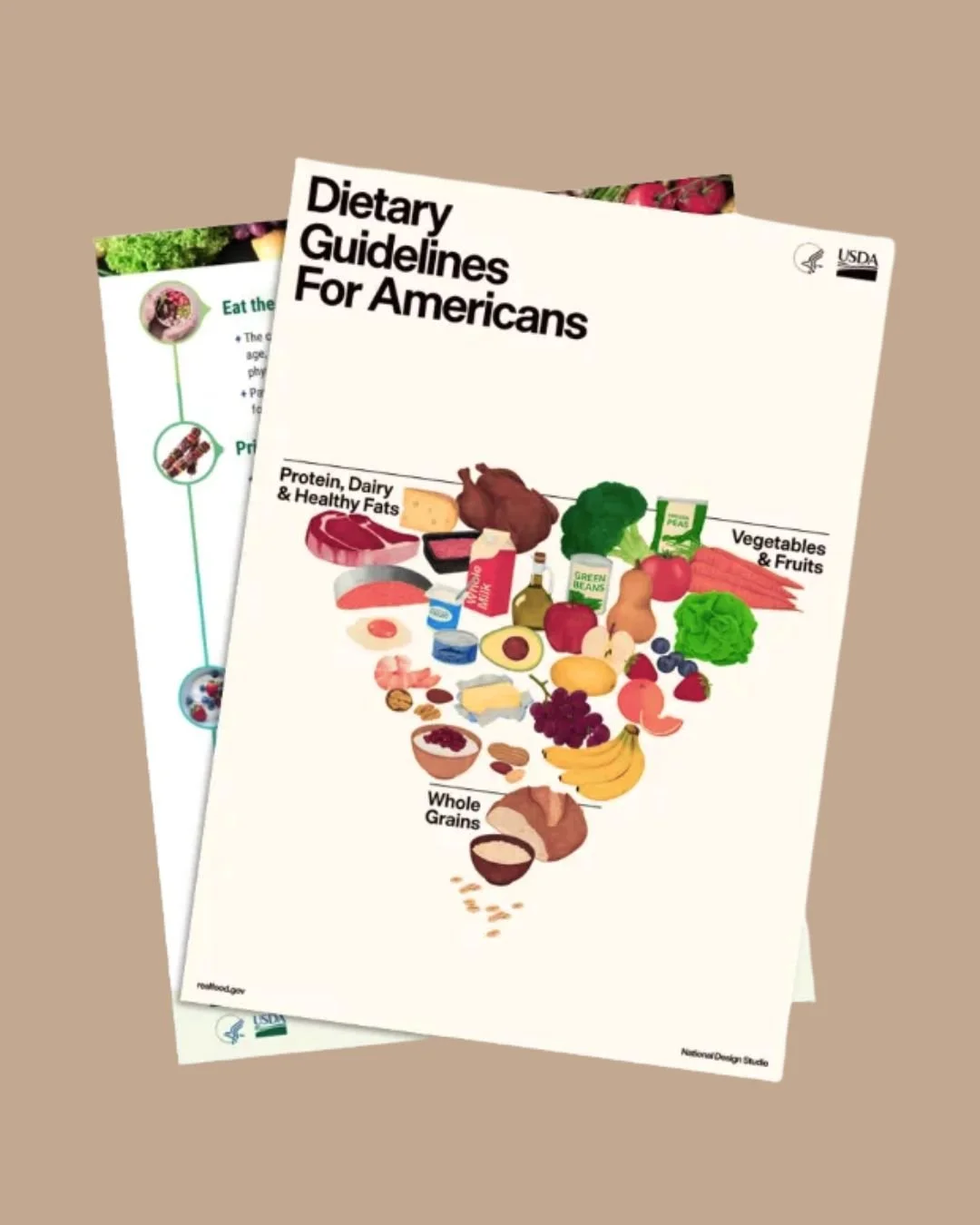
Not to Be Dramatic, but the 2025-2030 Dietary Guidelines Are Not Revolutionary - and That’s OK
Every five years, the Dietary Guidelines drop.
And every five years, the internet panics.
“This changes everything.”
“Protein is finally king.”
“Butter is back.”
Let’s slow this down.
Because if you’re a busy mom trying to eat better in real life, the noise is doing more harm than good.
First, a grounding truth
The Dietary Guidelines are not written for individual humans with toddlers, jobs, and zero margin.
They’re written for schools, hospitals, and federal food programs.
Big picture. Conservative language.
So if you were waiting for the government to say, “Eat more protein, lift weights, stop living on snack scraps,” you didn’t miss it.
They said it - they just weren’t quite that direct.
What stayed the same (and should not surprise you)
Despite the hot takes, the fundamentals didn’t move.
Fruits and vegetables still matter.
Fiber is still critical.
Whole foods still win.
Added sugar is still a problem.
Highly processed food is still out.
What actually changed (and why it matters)
This is where the update gets interesting and useful.
Protein finally got specific
Protein is now discussed in bodyweight-based ranges.
Not vague servings. Not “some.” Actual numbers.
And it’s emphasized across the day, not just at dinner.
This matters because most women under-eat protein until nighttime, then wonder why they’re tired, snacky, and running on fumes.
Protein isn’t a trend.
It’s a stability tool.
Full-fat dairy is no longer the enemy
The strict low-fat-only messaging softened.
Full-fat dairy is acknowledged as part of a healthy pattern.
This doesn’t mean adding cream to everything mindlessly. It means the fear-based messaging around fat continues to loosen.
Fat supports satiety.
Satiety supports consistency.
Consistency is the goal.
Gut health is no longer implied. It’s stated.
Fiber-rich foods and fermented foods are directly highlighted.
Not in a supplement-heavy way.
In a “your digestion affects everything” way.
Energy. Mood. Blood sugar. Immunity.
This is foundational, not trendy.
Whole grains are prioritized. Refined grains fade out.
Only whole grains receive intake targets.
Refined grains are quietly discouraged.
This isn’t anti-carb.
It’s pro-function.
Carbs without fiber are just energy with no brakes. We’ve talked about this.
The part busy moms actually need to hear
Nothing in these guidelines requires a total life overhaul.
They reinforce the same habits that work every time:
Eat enough protein.
Eat fiber consistently.
Stop relying on highly processed food to carry you through exhaustion.
Build meals that keep you full.
The MKH translation
If I had to turn the 2025-2030 guidelines into something usable, it would be this:
Protein at every meal. Non-negotiable.
Fiber daily. Not “when I remember.”
Fats that actually satisfy you.
Fewer foods that leave you hungry an hour later.
Less drama. More structure.
You don’t need to wait 5 years for permission to eat this way.
You need a setup that works when you’re tired, busy, and overstimulated.
If this helped cut through the noise, save it. Share it. Or send it to the mom who’s still waiting for the “perfect” plan to start.
Simple works. Systems stick.
– Mailoha
References
2025-2030 Dietary Guidelines for Americans
2025-2030 Daily Servings Guide
Scientific Foundation For the Dietary Guidelines
The Scientific Foundation For The 2020-2025 Dietary Guidelines For Americans Appendices